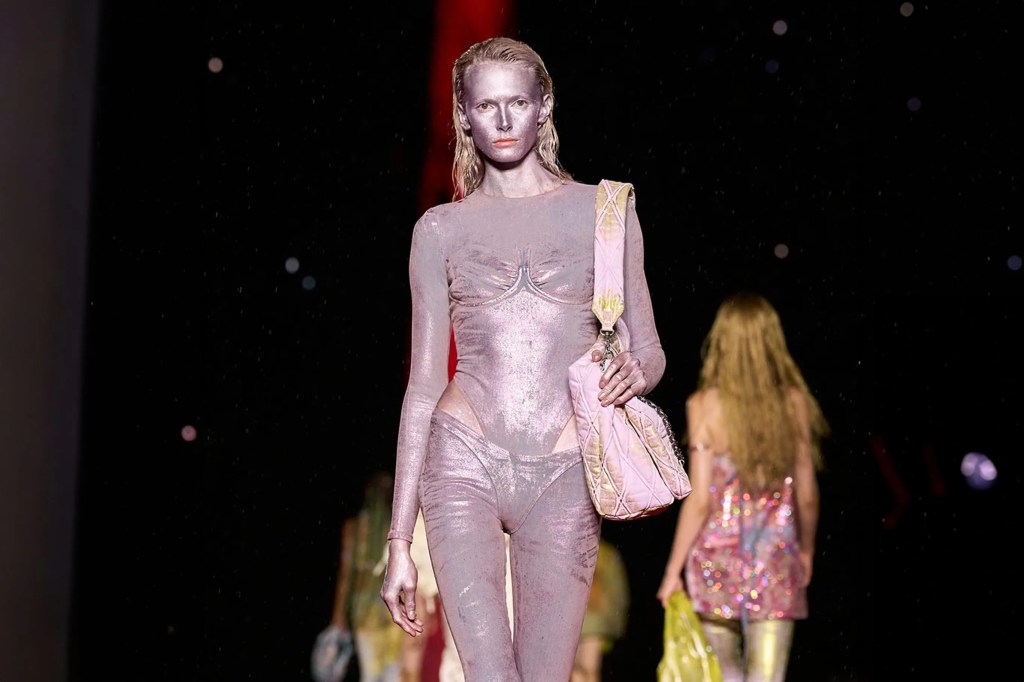
Diesel’s S/S 24 collection, held in the fashion capital of Milan, was a fashion show hidden within a festival-like setting, a performative play of painted models masquerading as extra-terrestrial futuristic characters – a subliminal trick to convince the audience that this collection was in fact ‘out of this world’.
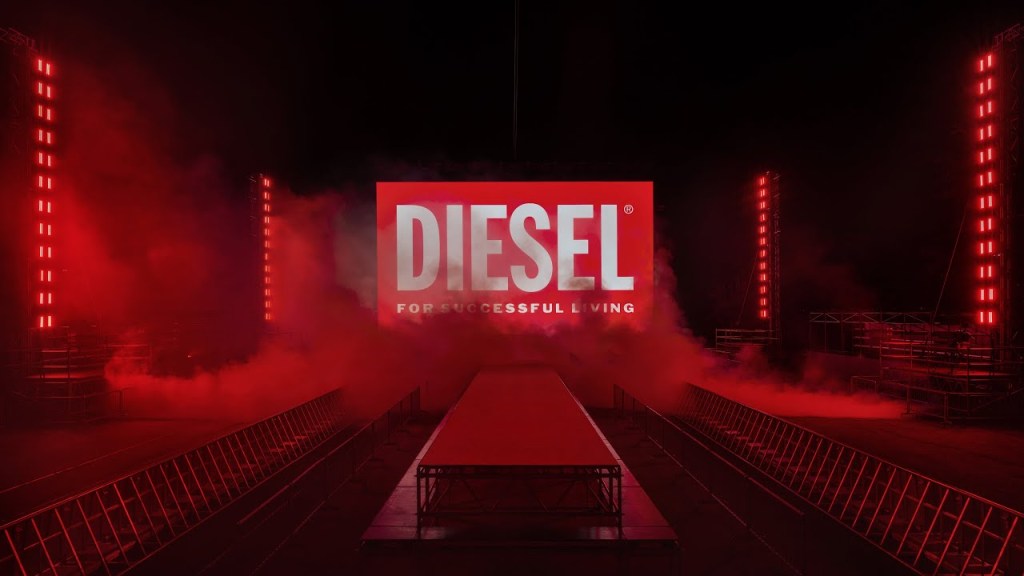
If the 90 minute (standing) wait in the pouring rain wasn’t enough to build anticipation, Diesel commanded our attention with a 60 second countdown clock on a huge screen, acting as a backdrop to the runway. This would later be used to show the birds-eye view of the show, unveiling a red carpet that had me thinking in equal parts about the bottom of a Christian Louboutin shoe and the exclusive red carpets at award ceremonies – whilst both are iconic, I now associate Diesel with this trademark.
The digital personalities taking off on the runway tapped into Martens’ approach to entertain the masses of the post-millennial generation with an audience of 7,000, to which the majority were students and/or digital nobodies. With this move, Diesel managed to gracefully challenge the institutional barriers we often see at these exclusive events. Without lowering their reputation to be one of the high-street, they have ensured that those who are destined to run the industry, not those who already are, are having their dopamine itch scratched.
An intentional aural assault of screaming alongside the quintessential ‘runway music’ oscillated between being very atmospheric and very dystopian. Unable to distinguish the real screams from the automated ones, I remained silent with my jaw ajar. At first, my astonishment was simply in regards to the models who were failing to fall despite the inundation of unwanted rain hindering their path, but it quickly transcended into my reaction of the clothes themselves.
Beginning with the basics, not in terms of vibe but foundations. From an iconic iteration of the micro-mini skirt, popularised by adversity, to metallic heels – their consistent identity of ‘edge’ was established. The usual motor and denim elements were elevated through textures. Being frayed, shredded, or having peeling paint – Diesel’s personification of effortless-looking, yet quality clothes is now becoming habitual.
Current trends always play a pivotal role in even the most innovative shows, for SEO reasons and to try and appeal to the masses whilst getting approved by the majesties. But, tapping into trends can be done in a pioneering manner. Whether or not the rain was anticipated, the slick back wet hair looks were reflecting the sleek and sexiness of the clothes. The arm cuffs, slouchy bags and hooded pieces are all additions that hold no revolutionary power, but can be styled in a way that reminds the audience of why they were popular in the first place.
Sheer suits and sheer dresses supported their gender neutral narrative and their increased use of tailored pieces enhanced their usual street-wear reputation. The lighting of the show, deliberate or not, made the models’ skin have a golden glow, simultaneously reflecting their celebrated metallics whilst referencing the show as a whole – smooth like butter.
Overall, the utilitarian theme (evident mostly through the apocalyptic mix of denim and red) coupled with the glamour of metallics, I believe was an ode to the glamourised realm of fashion. The alien-esque futuristic approach made a tangible statement that despite the utopia we were experiencing watching the show, a dystopian society isn’t one of distance – the world may be burning around us, but at least we were at the hottest party in town.
I judge the pieces by asking myself ‘Would I buy his if it was being sold at Primark?’, as most shows are for the purpose of attracting professional buyers. In all honesty, I would crawl into a dumpster to get even one of these looks.
Glen Martens. you’re a maverick.
 Georgina Lunn
Leave a comment