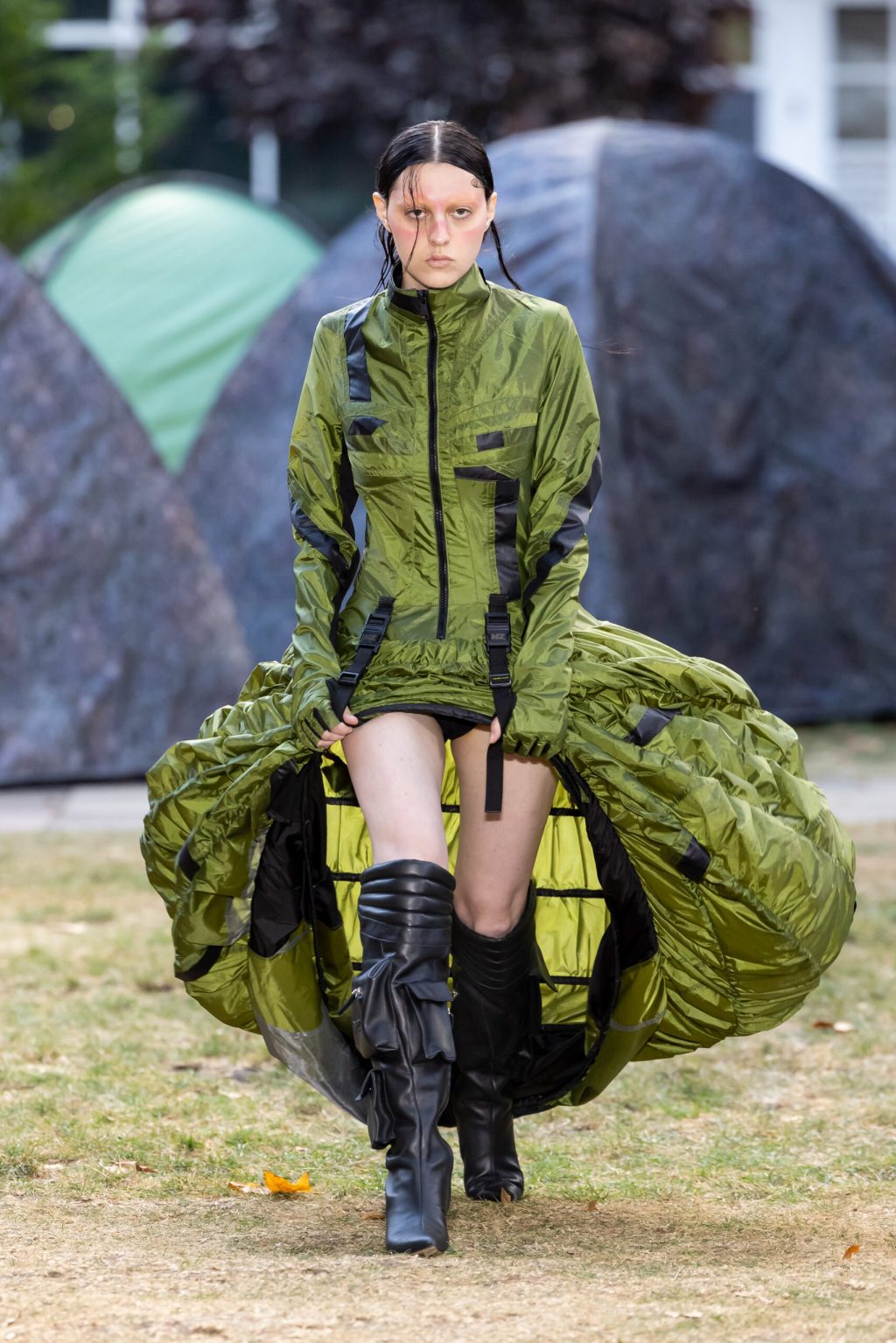
Imposter syndrome hit me hard last Friday night when I had the privilege to attend my first Fashion Show. My initial elation to just be in attendance made me question whether I would sentimentalise the show, regardless of the designer and their subsequent designs. However, from the moment I picked up my invitation (an engraved camping mug) all the way through to seeing the post-show Instagram content, the epiphany struck that my awe and admiration were not derived from anticipation and gratitude – but instead from the surprising synonymity between fashion and politics.
‘The Camp’, performed in the heart of London’s playground: Soho Square, completely eroded the concept of what ‘camp’, within the realm of fashion, means to me. In 2019, the theme of The Met Gala was ‘Camp: Notes on Fashion’ the perfect platform for the elite to project their love of artifice and exaggeration, flaunting couture and Avant Garde pieces crafted by names recognised from Rodeo Drive to Sloane Street. There’s nothing adverse about watching the well-known dress up and dine, the event itself holds reverence for dedicated designers. But whilst the idea that ‘camp’ was shown in a positive light is progressive in essence, due to society’s rooted issues with fruitiness and toxic masculinity, Natasha Zinko’s show redefined ‘camp’ once again.
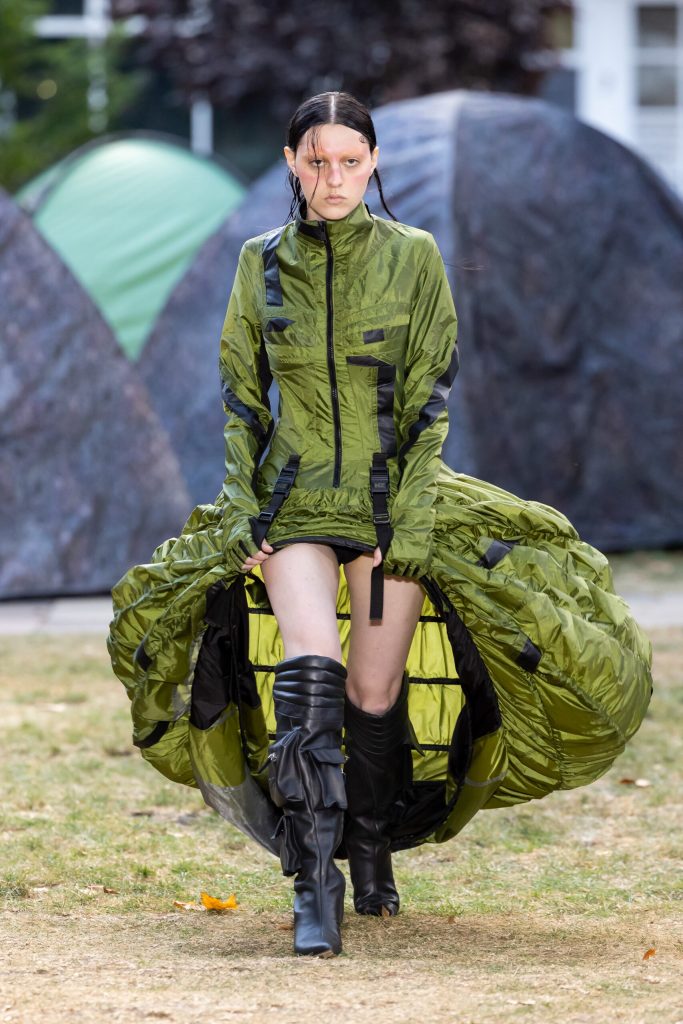
Paying homage to her Ukrainian roots, ‘Camp’ NZ SS24 punctuated the notion that the refugee crisis is no where near as apparent in our headlines as it was during the inception of the Russian conflict. This show reminded us not only of our ignorance and privilege, but the power fashion has to be a vehicle for change and engine for discourse.
Russia’s annexation of Crimea escalated its military presence on the peninsula, attempting to solidify the new status quo on the ground. The colonizing of Crimea was by definition successful, and furthered their military power. However, the combination of the flourishing democracy in Ukraine combined with global support prevents the Russians from determining any status quo. (Well that and because the country does not have a monopoly in oil or gas). Whilst we’ve seen the likes of McQueen and Lagerfeld ‘master’ the performative shows, neither have garnered this sense of political power or have used their platform to send a message both through the garments themselves and the intangible qualities of the show. Natasha Zinko does have the power to determine the status quo, she’s taken her opportunity for change, implemented a strategy and presented it to the leaders of the industry.
It wasn’t just the set of the pitched tents and camping-mug invitations that garnered this outdoor allusion, but the pure physical construction of the clothes too. We saw natural tones, with no splash of colours. Pieces so functional they either acted as a tent themselves or could at least carry one. In 19 looks, if it wasn’t biker boots or pointed heels with leg warmers – it was a sock and flipflop combination – a mix almost as controversial as Crocs.
Zinko was also clever enough to push her own agenda whilst simultaneously supporting current trends, such as biker boots and the layering of boxers. Ideas have to be conceptual before commercial, but adhering to the combination of both ensures sales as well as praise.
The intentional cut-outs throughout the 42 looks were an ode to the normal camping attire, where barbed wire, bramble bushes and falling over are normal occurrences. Slouching models, heavy music and stern faces also played into this camping character. Zinko’s spun the fashion narrative with this performative, political piece, hinting at emotional strength as well as physical strength (evident through the structural resemblance to a six-pack on multiple looks).
Playing into the infamous ‘Tabi’ trend, which is currently dominating the Gen Z fashion girlie population, of the split toe shoes. The ‘tabi split toe’ (immortalised by Maison Margiela in 1989) was inspired by the traditional 15th century Japanese sock, whilst the ‘split toe’ (no tabi) was inspired by late night campers needing a wild wee or refugees who had nothing else. Fashion isn’t always glamorous – it can still be found in war-time.
The entire collection held itself like it likes to be captured. Blending functionality, wearability and simplicity with quality, amplifying a thematic assembly. Natasha Zinko is a paragon who has certainly put her name on the map, and drawn attention to her country on the map by putting a whole new meaning behind the word ‘camp’.
From lawyer, to designer, to pioneer. It was an honour to attend.
 Georgina Lunn
Leave a comment