Written for Wise Wellness’ upcoming digital newsletter
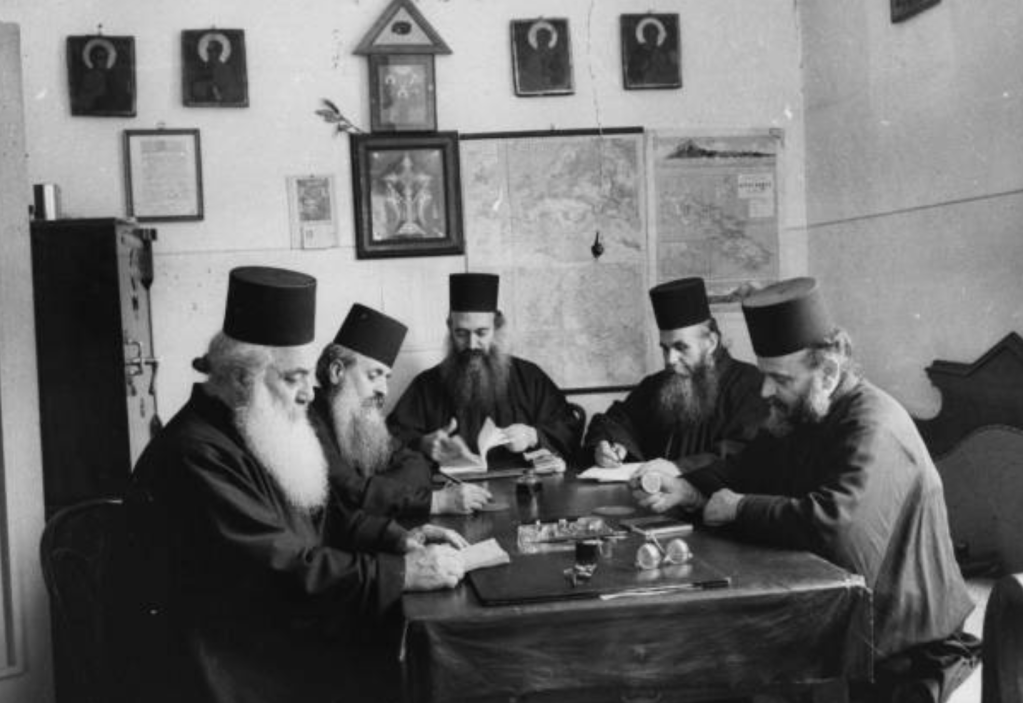
Having grown up hearing an oft-recounted story about a relative visiting the restricted Mount Athos, to discovering an old National Geographic article on the same subject, and more recently reading a contemporary account in The Times, I’ve long been fascinated by how the monastic lifestyle has endured not just for decades, but for centuries.
Across these accounts, separated by three decades and distinct editorial sensibilities, one truth resounds: Mount Athos hasn’t changed. And in that stasis, so anathema to our age, lies something profoundly radical.
Mount Athos is not a museum of orthodoxy, it is a living system: twenty monasteries, self-governed under Byzantine law, populated by monks who rise before the sun and move through the day with a deliberateness that borders on the liturgical. Resting on a peninsula in northeastern Greece, renowned as a major center of Eastern Orthodox monasticism resides rhythms that are astonishingly precise, yet free of rigidity.
The monks are not utopians – they are custodians of a practice that predates capitalism, digital infrastructure, and even the notion of oneself as a project. Their way of life is not a rejection of the modern world, but a refusal to participate in its acceleration.
Sustainability Not as Trend, But as Ontology
In contemporary discourse, ‘sustainability’ is often reduced to carbon metrics, recycling initiatives, or minimalist aesthetics. But on Athos, sustainability is not a choice – it is a condition of survival. Here, it manifests not in slogans, but in systems: ecologically, the land is cultivated with patient repetition, not exploitation. Bees are kept, olives are pressed, wood is gathered from forests walked daily for decades. Psychically, silence and solitude are not escapes from society; they are intentional structures for mental clarity, with the daily rhythm of prayer becoming an unconscious practice.
But what is rhythm without performance? It’s a striking contrast to our culture of display, where even slowness is often aestheticised, packaged into wellness trends or minimalist brands. But Athos is neither a lifestyle brand nor a retreat centre. It has no entry point for commodification. And therein lies its sustainability: what cannot be monetised, cannot be destroyed.
For a generation disillusioned by burnout, and infinite scrolling, the Athonite way offers something startlingly unfamiliar: a refusal to move faster. It’s not escapism, it’s a confrontation. To live monkishly in our world may not mean reproducing, but reorientation. Less as a wholesale adoption of monasticism, and more as a revaluation of rhythm, rest, and repetition. Monastic life does not solve the crisis of modernity, but it offers a counterpoint, a culture that has not collapsed under the weight of self-exhaustion.
Literate Proof of Athos’ Preservation (NOT A STANDARD MONASTIC ENCLAVE)
In 1993, a relative of mine, under the alias Slater Todd, smuggled himself onto Mount Athos with a compass and a desire to test the firmness of his agnosticism. He tossed his bag over a fence, scaled a barbed wire strand, and walked into the forest like a 20th-century mystic turned border-crosser. Athos only had a strict quota of 10 foreign visitors a day, and was booked up for 2 months so Todd wasn’t given permission, despite having a letter of recommendation from the Ecumenical Patriarch of the Greek Orthodox church in Constantinople, which has ecclesiastical jurisdiction over Mount Athos. Without a permit, there is no diamonitirion – and without a diamonitirion, no visit to the Holy Mountain, unless one were to flout the law. So, he entered not through the Byzantine gate, but through the undergrowth – as a pilgrim of doubt, not faith. Yet what he found was not exclusion, but hospitality. The men he first encountered were confrontational until Todd’s known charm dispelled onto them. They revealed, in Greek, their lumberjack trade, then proceeded to share ouzo and joke about women in sign language with him. He met men from all walks of life, a young Australian monk, a Greek pilgrim, an Australian pilgrim, a German theology student, two English monks, and a Macedonian. But despite the approximate 2,000 monks on Mount Athos, “Even in the largest monastery in mount athos (Megisti Lavra), there is indescribable peace”.
Cassocks and censers aside, he witnessed a culture held together by a centuries-old routine that didn’t care who you were, only how you moved through the day.
The Independent published his piece in 1994 under the title “An Agnostic on the Holy Mountain”, and whilst upon return he sustained his agnosticism, he understood wholeheartedly why these men chose this way of life. A life not for all, some would return to their homebound origin, some would stay until their day of rest, and some, like Todd, would exist merely as a visitor but always remain an ally. The sentence that struck me most from this first-person narrative was “The food was given to me freely, as if it were my right. No one ever asked to see my diamonitiron.”
That same rhythm of monastic life was evident in the 2010s National Geographic piece “Called to the Holy Mountain” by Robert Draper. With bells ringing at 4 a.m., the scratch of brooms on stone corridors, and the chants in ancient Greek that haven’t changed in over a millennium – Slater Todd’s first person recount could be mistaken as a mirror to this piece’s tellings. The magazine, often obsessed with endangered cultures, could only conclude that this world was “not in danger of extinction, but of misinterpretation.” The monks’ refusal to perform for the camera was mistaken for obscurity. In truth, it was sovereignty. As Draper wrote, Athonite Orthodoxy is “dedicated purely to prayer” – a phrase that, in our time, reads as alien, almost subversive. This radical focus on the divine demands a retreat from all worldly attachments, which is why women aren’t forbidden because of their weakness, but because of man’s – for if they were allowed to interact, men would marry them and never return.
In 2024, Janice Turner, through The Times, returned with an account of exclusivity. With a quiet dissent she recounted that “the pleasure boat we took along the peninsula must keep 500 metres from the shore since it contains female passengers”, The distance isn’t just maritime protocol; it’s metaphysical. The mountain does not entertain negotiation as its rules are not designed for commentary; they are designed for continuity. Turner points out that this kind of strict order isn’t unusual. “A human yearning for the correct rules to live by is hardwired; the means of sating it simply shifts from Byzantine brotherhoods to Gwyneth Paltrow’s Goop.”
A Philistine Masquerading as a Pilgrim
I sometimes wonder what kind of visitor I would be. In a world where pilgrimage is often just spiritual tourism in linen, would I enter Athos merely as a collector of experiences? So many of us approach these spaces as a philistine masquerading as a mystic, expecting transformation as a consumable outcome. But Athos offers no epiphanies on demand. The “Holy Mountain” isn’t designed for revelation – it is built for repetition.
And this is precisely what makes it so sustainable. In an age where identity is curated and attention is scattered, the monks have chosen a different logic: a fortress of form over a sanctuary of escape.
The Tyranny of the Empty Room
The tyranny of the empty room is a metaphorical phrase that refers to the oppressive or overwhelming feeling that can come from being alone with your own thoughts, especially in a silent or isolated space.
In short, monks reverse the tyranny by shifting their relationship with the silence, the self, and the present moment. The empty room becomes not a cell, but a sanctuary.
To live on Athos is to relinquish the modern fantasy of freedom as infinite choice. This is what so many of us fear when we romanticise monasticism: not the silence, but the structure. The monk’s cell is a confrontation – a room with no diversions, no dopamine cycles, no performative productivity. The tyranny of the empty room is what we avoid when we reach for our phones, or change cities every year. But the monk that walks into that room daily, and stays, is not fueling deprivation, but sustaining their soul.
The Monkish Life Is the Original Wellness Architecture
We speak of sustainability now as if it were an innovation. But Mount Athos has practiced it since the 10th century. It is the epitome of wellness, stripped of brand strategy and biohacks. The monks are not aiming to ‘live better’ or ‘feel more balanced’, they seek nothing but continuity with the divine. And in doing so, they’ve incidentally created a model of psychological, ecological, and communal sustainability more complete than any Western theory.
This isn’t about gender exclusion, or theological rigidity. It’s not an argument against feminism or liberalism or the world beyond. It’s about an experiment in endurance – a place where the slowest rhythm won.
Legacy
Three articles, three decades, three very different writers. And yet, the same conclusion echoes through them all: Mount Athos hasn’t changed.
In that immovability lies not nostalgia, but authority. It is a rare proof of concept in a world that measures meaning by movement. While we seek silence in noise-cancelling headphones, Athos has preserved it in stone. While we scroll for wisdom, they repeat the same prayer that echoed through the caves of Cappadocia. While we constantly search along a path for something new, monks walk along a “cobbled track replaced by a great scar of dirt road” – Slater Todd, 1994.
What these articles taught me is that the monks haven’t changed but the people who approach them have. From Todd, to Draper, to Turner, each recount becomes more negative. Granted, it’s a select sample, but the point stands: contemporary visitors now bring with them the changing tides of modernity – expectations shaped by a culture of speed and instant gratification. This contrast highlights not only the resilience of the monastic way but also how it serves as a mirror, reflecting back the restless impulses of contemporary life.Mount Athos may be the extreme version of the simple life, not to be trivialised as it remains the orthodox emblem of stoic religious dedication. But, for those of us navigating the relentless pace of modern life, the monastic commitment to rhythm, rest, and intentional simplicity offers a vital reminder: meaningful balance comes less from chasing novelty and more from creating steady, deliberate habits that support both mind and body.
 Georgina Lunn
Leave a comment